


 Lyndon Docherty
I've spent the past year watching something fascinating unfold. The C-suite has gone all-in on AI. Not just budgets—their careers are now tied to it.
Half of CEOs now believe their job is on the line if AI doesn't deliver. They're spending over eight hours a week upskilling themselves on the technology. Companies are planning to double their AI spending in 2026.
This isn't experimentation anymore. It's existential.
But here's where it gets interesting.
The Commitment Paradox
Ninety-four percent of chief executives say they'll continue investing in AI at current or higher levels—even if it doesn't pay off in the next year.
Read that again.
They're committed to spending money on something they're not confident will work. Only 44% of UK CEOs believe AI will actually pay off, compared with 52% in the US and 61% in Europe.
CEO Confidence Gap
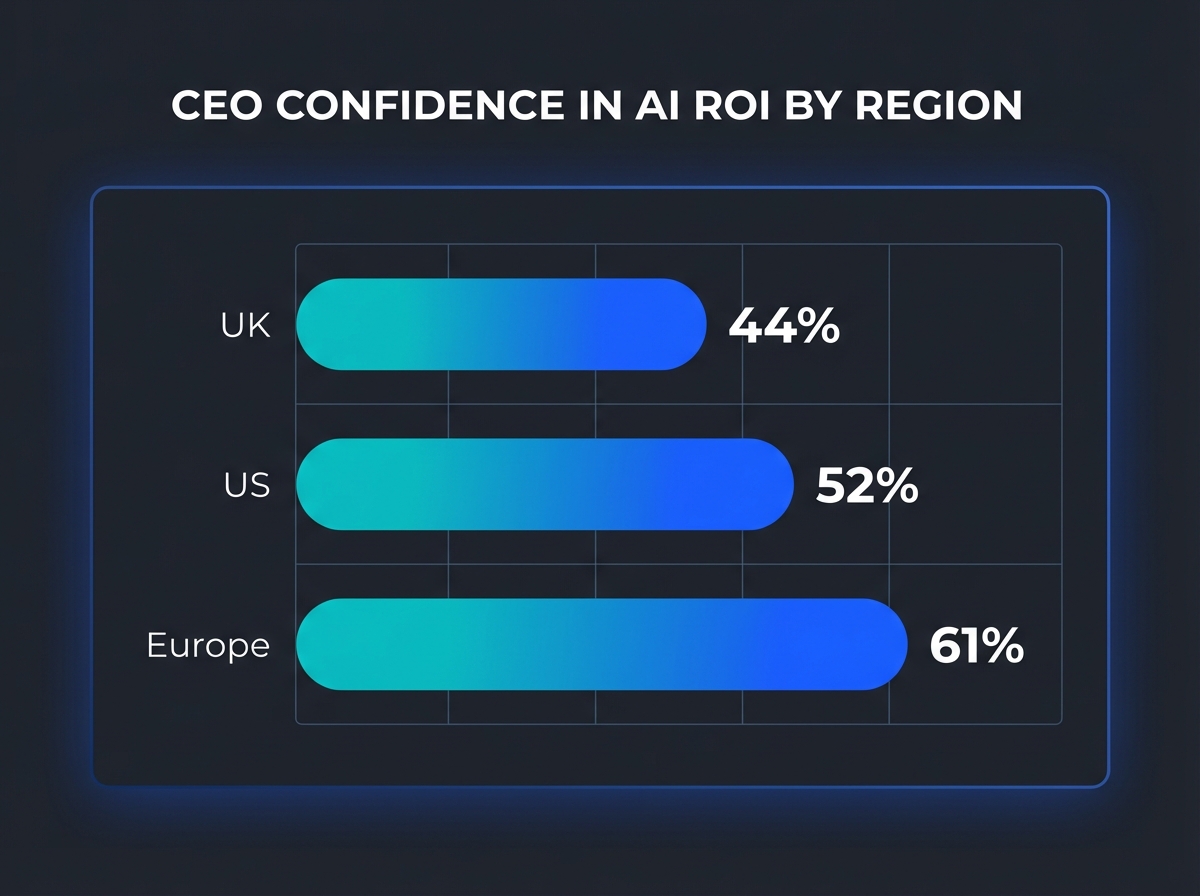
Source: BCG Findings on AI Investment Sentiment (2026 projection)
This is the corporate equivalent of building a house by writing a £1 million cheque to a builder before you've checked if you can get planning permission.
You're committing the most money when your risk is at its highest.
Why This Matters Right Now
I've been in enough boardrooms to recognise what's happening here. Leaders are making fear-based decisions dressed up as strategy.
Western CEOs, in particular, are investing in AI primarily to avoid falling behind. Not because they've identified clear value. Not because they've tested and validated use cases. Because everyone else is doing it.
The result? Organisations are locking themselves into large commitments with vendors and consultants before they actually know what they need.
And the data backs this up.
88%
Enterprises using AI regularly in at least one function
6%
High performers seeing meaningful 5%+ EBIT impact
Despite 88% of enterprises now using AI regularly in at least one business function, only 6% are high performers seeing meaningful bottom-line impact of 5% or more in EBIT.
Six percent.
That means 94% of organisations are spending heavily but not seeing the returns they expected.
The Real Problem
The issue isn't AI itself. The technology works. I've seen it deliver remarkable results when deployed properly.
The problem is how organisations are investing in it.
They're following the same playbook they've always used: hire a big consultancy, agree a large upfront contract, commit to a multi-year programme, then hope it works out.
This approach made sense in a world where requirements were stable and outcomes were predictable.
AI isn't that world.
You don't know what you really need until you start working with it. The best use cases emerge through experimentation, not through six months of upfront planning.

A Different Approach
Start small. Spend the absolute minimum to test an idea. Learn something real. Then scale based on what you've proven, not what you've guessed.
This is how the 6% of high performers are operating. They're pushing for transformative innovation, redesigning workflows as they go, and scaling faster because they're not locked into plans that were wrong from the start.
"When you're at peak uncertainty, you should be at minimum spend. As certainty grows through actual delivery and real results, that's when you increase investment. Not before."
What You Should Do
If you're a CIO, CTO, or transformation leader being pressured to make big AI commitments right now, push back on the traditional engagement model.
Don't write the million-pound cheque upfront.
Get the best person for the specific challenge you're trying to solve. Use them for three days to validate the approach. Learn fast. Pivot if needed. Then scale with confidence.
The organisations winning with AI aren't the ones spending the most. They're the ones learning the fastest.
Your job might depend on AI paying off. But it definitely depends on how you invest in it.
Written by
Lyndon Docherty
Expert contributor at HiveMind Network, specializing in digital transformation and strategic AI implementation.