


D igital transformation programmes rarely fail in the way we expect. Systems go live. Data migrates. Roadmaps are delivered. Status reports turn green. Steering committees disband. Success is declared.
And yet, six to twelve months later, the promised improvements in productivity, customer satisfaction, risk reduction or revenue growth are difficult to evidence. Operational costs have not reduced as forecast. Customer journeys remain fragmented. Staff continue to work around new systems. The anticipated commercial uplift appears marginal at best.
This is not a delivery failure. It is a value failure.
Across sectors, organisations have become highly capable at managing delivery. What remains underdeveloped is the structured discipline of benefits management and value realisation — the capability to translate digital investment into measurable, sustained business outcomes.
For CIOs and transformation leaders, this gap represents both a risk and an opportunity.
Delivery Metrics Are Not Value Metrics
Traditional programme governance focuses heavily on scope, schedule and budget. These are necessary controls. They are not indicators of value.
Outputs
Deliverables: systems implemented, processes redesigned, tools deployed. Most transformation governance structures track outputs diligently.
Outcomes
Behavioural or operational shifts: faster decision-making, reduced cycle times, improved data quality. Fewer systematically track outcomes.
Benefits
Measurable improvements linked to strategic objectives: margin expansion, risk reduction, growth acceleration, customer retention.
A platform deployed on time and on budget can still fail to deliver commercial impact. Without clarity on the difference, organisations risk mistaking activity for achievement.
Why Benefits Erode After Go-Live
Value leakage typically occurs in three predictable phases. If left unmanaged, these factors silently dismantle the business case.
1. Business Case Assumptions Go Unchallenged
Business cases are often based on modelling assumptions that are rarely revisited. Market conditions change. Organisational priorities shift. When assumptions are not stress-tested throughout the lifecycle, the link between investment and value quietly weakens.
2. Benefits Ownership Is Diffuse
IT delivers systems. Operations delivers process changes. Finance tracks cost. But who owns the realized benefit? When benefits sit “between” functions, accountability dissipates. Project teams disband, and operational teams inherit change without owning the value case.
3. Adoption Is Assumed, Not Managed
Technology rarely fails because it does not work. It fails because it is not used in the way required to unlock value. If new digital workflows are bypassed or legacy spreadsheets persist, projected benefits remain theoretical.

Elevating Benefits Management to a Strategic Discipline
1. Define Benefits in Measurable, Financially Coherent Terms
Benefits should be quantified wherever possible, linked directly to enterprise strategy, and expressed in terms understood by the CFO and board.
2. Appoint Named Benefit Owners
Every major benefit should have a sponsor accountable beyond go-live. This sponsor should validate baseline metrics, commit to adoption actions required, and report on realised performance post-implementation.
Benefits ownership should not end when the programme closes. It should extend until measurable outcomes are demonstrably embedded in operational performance.
3. Integrate Benefits Tracking into Executive Governance
Benefits dashboards should sit alongside financial and operational reporting, not in separate transformation updates. Leading indicators — adoption rates, utilisation metrics, behavioural KPIs — should be tracked early.
Lagging indicators — cost savings, revenue growth, margin improvement — should be monitored over time. Transformation success must be discussed in the language of enterprise performance, not technical completion.
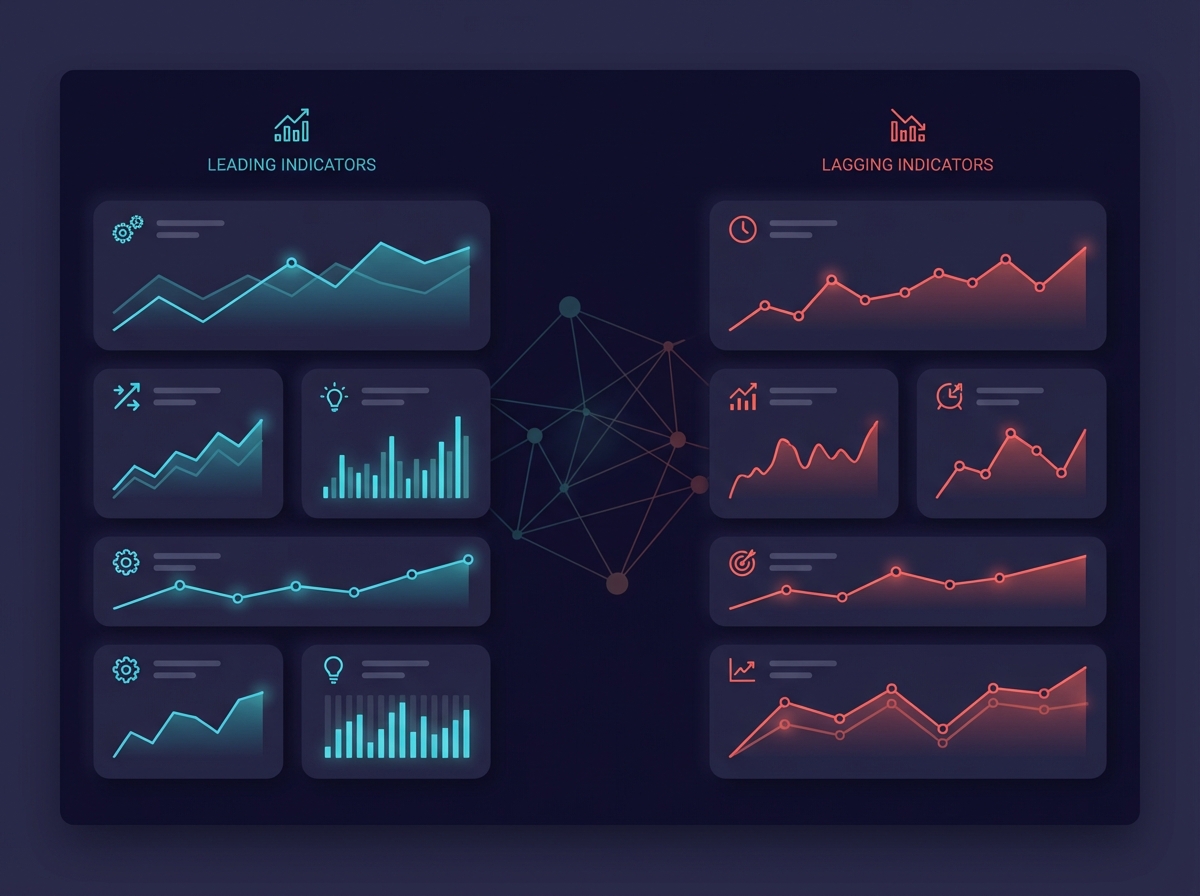
The Value Early Warning System: Identifying leading indicators during programme design allows for corrective action before lagging financial benefits are missed.
The Cultural Shift: From “Delivery Success” to “Value Accountability”
Perhaps the greatest shift required is cultural. Many organisations still reward teams for delivering projects, not for realising value. Once milestones are achieved, attention moves to the next initiative.
A value-centric organisation behaves differently: Funding decisions are revisited based on realised impact. Underperforming benefits trigger corrective action, not retrospective justification.
For PMO leaders, this requires evolving from schedule guardians to value stewards. For CIOs, it requires strengthening the commercial narrative of technology investment. For transformation leaders, it means aligning change, adoption and operational ownership with financial outcomes.
Leading and Lagging Indicators
Leading Indicators (Early Warning)
- → System utilisation rates
- → Process compliance metrics
- → Customer engagement patterns
- → Employee adoption scores
- → Data quality benchmarks
Lagging Indicators (Financial Impact)
- → Revenue growth
- → Cost reduction
- → Margin improvement
- → Market share expansion
- → Customer lifetime value
The Governance Imperative
In complex transformation portfolios, benefits management must operate at both programme and enterprise level. Portfolio governance should answer: Are projected benefits still aligned with strategy? Is capital allocated to the highest value initiatives? Where are benefits underperforming? What corrective interventions are required?
Without enterprise-wide visibility, organisations risk duplicating investment or prioritising initiatives with weak return profiles. Value realisation should influence funding cycles. Future investment should be contingent on demonstrated impact from prior programmes. This creates a virtuous cycle of accountability and performance.
The Role of Independent Challenge and Ecosystem Expertise
Even the most capable internal teams can struggle to objectively assess value realisation. Organisational politics, sunk cost bias and delivery fatigue can cloud judgement. Independent expertise provides objective benefits validation, benchmarking against cross-sector experience, and rapid diagnostic of value leakage points.
An ecosystem model — bringing together proven specialists rather than relying solely on fixed internal structures — enables organisations to access targeted expertise precisely when required. For CIOs and transformation leaders, this reduces risk while accelerating measurable returns.
Reframing Success in Enterprise IT
When benefits management becomes embedded, IT shifts from cost centre to value engine. Transformation becomes measurable rather than aspirational. Executive confidence in digital investment strengthens. Funding decisions become evidence-led.
The Question Every Transformation Leader Should Ask
Not “Did we deliver?” but: “Where is the value, and can we prove it?”
The organisations that can answer that question with clarity, evidence and confidence will outperform those still measuring success by milestones alone. Benefits management is not administrative overhead. It is strategic discipline. In the next wave of digital transformation, it may be the defining factor between transformation that changes systems — and transformation that changes performance.
Written by

Glyn Hurll
Glyn is a senior leader within the HiveMind Network, specializing in digital transformation strategy and value realization. With extensive experience across global sectors, he helps organizations bridge the gap between technical delivery and commercial impact through rigorous benefits management and operational governance.